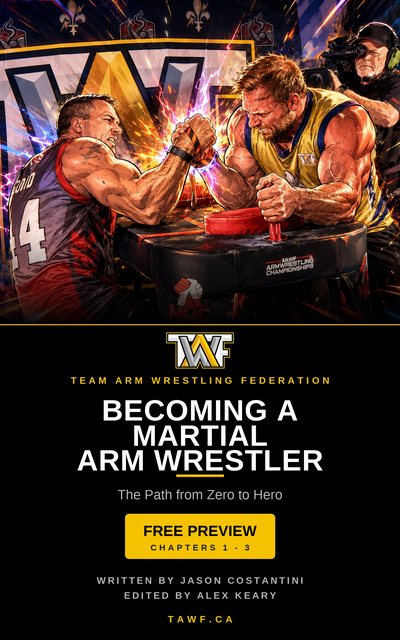
Few sports are as widely misunderstood as arm wrestling. Most people's instincts about it — that it's a raw strength contest, that it's all biceps, that it's harmless — are wrong, and those wrong instincts are what lose matches and get people hurt. Here are the myths worth unlearning and the mistakes worth avoiding.
Myth: the strongest (or biggest) person always wins
This is the big one, and it's false. Technique and leverage routinely beat raw strength. By controlling an opponent's wrist and the angle of their elbow, a skilled puller limits how much of their strength actually reaches the hand — so a smaller, more technical competitor can and does beat a stronger novice.
It's not that strength is irrelevant; at the elite level everyone is both strong and technical. But strength alone is beatable, which is the whole reason the sport runs weight classes and rewards years of skill. If size settled it, there would be nothing to learn.
Myth: it's all in the biceps
The biceps matters — mostly by holding the elbow bent — but it is not the prime mover. Real driving force comes from the forearm and wrist controlling the hand and from the shoulder rotators, lats, and chest turning the arm over. Treating arm wrestling as a biceps contest means training the wrong things and pulling with the wrong muscles. (See what muscles arm wrestling works.)
Myth: it's safe, especially if you're the bigger one
Two dangerous beliefs hide here. The first is that a bigger or stronger person is safe — but medical reviews are clear that the opponent's strength does not determine whether a bone breaks, and fractures happen even between evenly matched pullers. The second is that casual "just for fun" matches are harmless, when in fact almost all arm wrestling fractures happen in recreational and bar matches, not in sanctioned competition. The casual setting is the dangerous one, precisely because there's no referee, no warm-up, and no one willing to concede. (The full mechanism is in arm wrestling injuries.)
Common technique mistakes
- Leading with raw strength. Trying to overpower the opponent instead of controlling their hand. It gasses you out and leaves you exposed.
- Letting the arm drift back. Keeping the elbow tight and the arm in front of the body is both stronger and safer; letting the arm fall behind you is the weak, dangerous position.
- A wrist that flops back. Whoever has the stronger, more controlled wrist usually wins. A wrist bent backward is a structural failure you rarely recover from.
- Reaching and leaning away. Standing too far back or leaning back forfeits leverage and bodyweight. Get your shoulder behind and over your hand.
- Turning your head. Looking away makes your body rotate the wrong way — bad for technique and a direct contributor to injury. Keep your eyes on your gripping hand.
- Underestimating a smaller or "weaker-looking" opponent. Appearance doesn't determine capability; a good toproller can beat you before you've engaged your strength.
Common training mistakes
- Ego-pulling into injury. Doing too much hard table time too soon. Tendons adapt slower than muscle, so overtraining them is the number-one beginner injury — sometimes within a couple of weeks. (See how to train.)
- Neglecting the wrist extensors. Training only the flexing side of the forearm creates an imbalance that leads to elbow pain. Balance heavy flexion with light extensor work.
- One-dimensional training. Building general gym size without the sport's specific movements — cupping, pronation, the riser, side pressure — underperforms at the table.
- Skipping warm-ups and deloads. Cold tissue fails more easily, and adaptation happens during recovery, not during the session. Both are non-negotiable.
The mistake that matters most
If you remember one thing: concede a lost position. The single most dangerous mistake in arm wrestling isn't a technical one — it's pride. Throwing your whole body into rescuing a match you've already lost is the exact mechanism that breaks the upper-arm bone. Tap, give the pin, and pull again. A loss costs you nothing; a fracture costs you a year.
Where to go next
- Learn the moves the right way in the techniques guide.
- Understand the safety mechanism in arm wrestling injuries.
- Train smart with how to train for arm wrestling.
- Start from the top with Arm Wrestling 101.