Amateur
No Elimination
Entering on your own.
An individual, open tournament with no knockout. Newcomers and experienced pullers compete side by side, and nobody is knocked out of their pulls.
Read the No Elimination rules
League
Every TAWF format, in one place. Find your format, see the three side by side, then read the rules every match shares.
Find your format
TAWF is built as a three-tier ladder, and an athlete can start at the bottom and climb. Find the event you are entering. That is your page.
Amateur
Entering on your own.
An individual, open tournament with no knockout. Newcomers and experienced pullers compete side by side, and nobody is knocked out of their pulls.
Read the No Elimination rulesSemi-Pro
Your club is sending a team of three.
A local TAWF team tournament for clubs, with the strategy and point system of the pro game. Teams compete for the pot.
Read the 3v3 rulesFull Pro
On a franchise roster.
The Official 8v8 Franchise Game: city-versus-city play between eight franchises, with managers and the complete point system.
Read the 8v8 rulesThe 3v3 Team Showdown and the No Elimination Tournament are local TAWF events, and they often run on the same day, so the amateur and semi-pro tiers run side by side.
Women. Women compete in the No Elimination Tournament, and in the Women's Division of the 8v8: each league team has three women on its roster, who pull a women's 3v3 league game before the men's 8v8 game.
| AmateurNo Elimination | Semi-Pro3v3 Team Showdown | Full Pro8v8 | |
|---|---|---|---|
| Competes as | Individual | Team of 3 | Team of 8 per game, from a roster of 12 |
| Matches per game | Everyone in your group pulls everyone; the count depends on group size | 12 matches, 4 rounds of 3 | 32 matches, 4 rounds of 8 |
| Weight classes | Men
Women
| Men
Women
| Men
|
| Who picks who pulls | Nobody | The Team | The Manager |
| Captain win | Not used | +1 point | +1 point |
| Gambles and timeouts | Not used |
|
|
| Who calls gambles and timeouts | Not used | The Team | The Manager |
| Challenging a call | No. The Head Referee's call is final | No. The Head Referee's call is final | Forced review by the Manager. If the call stands, the team loses a timeout |
| Pulling Up | +1 point per class above your own | +1 point per class above your own | +1 point per class above your own |
| Shutout | Not used | +5 points for all 4 matches in one class, both arms | +5 points for all 4 matches in one class and arm |
| "Look at your hand" | Given once, then a Position foul if not corrected | Awareness only. No foul | Awareness only. No foul |
| Flagrant foul | Loss of the match. The athlete is out: later matches are +5 wins for the opponent, no ranking, no medal | Loss of the match. The offender is out: later matches are +5 wins for the opponent | Loss of the match. The Head Referee may eject; the league reviews every one |
| A game is won by | No games: every match counts toward your group total | First to 100 points, or most points after 12 matches | First to 100 points, or most points after 32 matches |
| A tied game | Not used | The Silver Bullet | Extra rounds until a team reaches 100 |
| Standings order |
|
|
|
| The tournament is won by |
| The top four after two qualifying rounds go to the finals: 1st v 2nd for the Championship, 3rd v 4th for Third Place | A season: the top team in each conference meets in the Grand Final |
Same in every format
These rules hold in every format, from a first No Elimination pull to an 8v8 game. Where a format does something differently, the rule says so, and the detail is on that format's page.
Every TAWF match is pulled on the MAC Table. Ian Carnegie created it and named it after his promotion, MAC (Major Armwrestling Championships). TAWF was co-developed with MAC. The table is best understood as a table and a rule set together, with one goal: matches that start fair and consistent, and end on pins, not fouls.
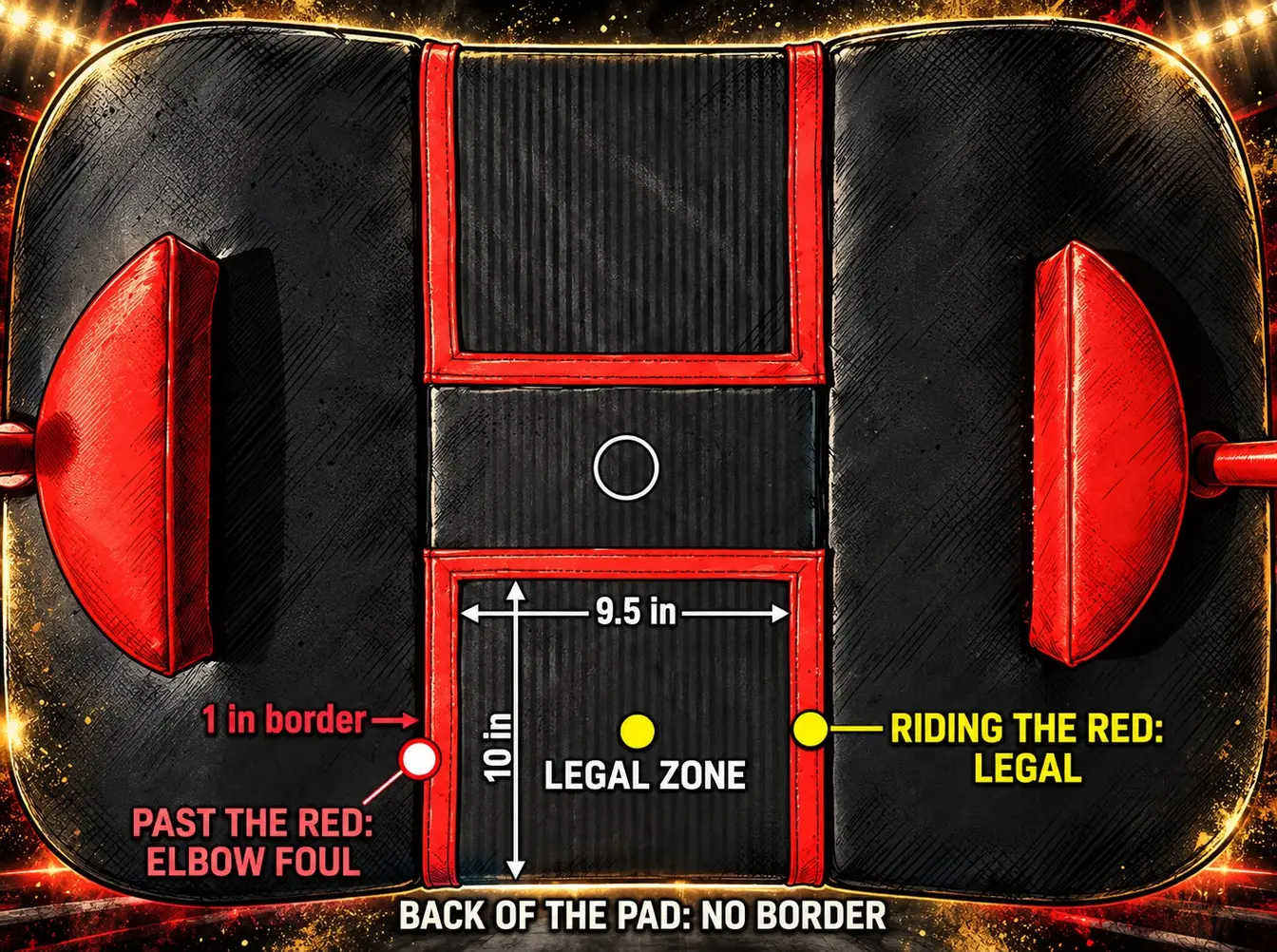
The signature feature is the elbow pad: a 9.5 inch by 10 inch black interior pad with a 1 inch raised red border on three sides, and a recessed center. The back of the pad has no border: the pad simply ends at the edge of the table. The pad is larger than a standard pad, so the elbow has more room to travel during a pull, and the red border turns a judgment call into a line everyone can see.
The referee judges elbow position by angle and motion at the line. Because the line is physical and color-coded, and both athletes and the referee can see it, the call is consistent.
The referee sets the grip for both athletes. Webbing and palms come together, the referee holds the fingers so they point toward the opponent's chin, and both elbows stay firmly on the pad through the set.
Each match is a single pull, and only the winner scores.
Every foul is a stop foul. There are no warnings. The instant a foul happens, the action stops and the foul is called. Three fouls in one match is an automatic loss of that match.
Covering the opponent's thumb knuckle when closing hands.
Moving the hand, wrist or arm before the referee says "Go."
Touching the chin, shoulder or head to the competing hand.
The elbow crossing past the red border of the pad.
Intentional foot contact with the opponent.
Losing contact with the peg using the non-competing hand.
Back pressure or side pressure before "Go," moving the opponent off-center.
Dropping the competing shoulder below the elbow pad in a losing position.
The shoulder crossing the center circle, or making contact with the hand.
Not at the table before the clock reaches 0:00. See Late to the table.
Between matches, the clock runs 30 seconds, in every format.
If an athlete is not at the table when the clock reaches 0:00, it is a foul, and the clock resets to 30 seconds.
Only the winner of a match scores, and these points count the same way in every format. Every match pulled at any TAWF event is recorded: the winner's points go into the athlete's stats and standings on the league platform.
| Result | Points | Notes |
|---|---|---|
| Win | +5 | To the winner of the match. |
| Loss | 0 | Only the winner scores. |
| Loser's foul | +1 per foul | Added to the winner for each foul the loser commits. |
| Winner's foul | -1 per foul | Taken from the winner for each foul the winner commits. |
| Flash pin | +1 | A pin within 0.5 seconds of "Go." |
| Forfeit | +5 flat | To the present opponent. No bonuses and no foul swing. |
These weigh-in rules apply in every format.
Your weight sets your class. Each format has its own classes, and all of them follow one pattern: a class runs up to the .9 of its top pound, and the next class starts on the whole pound. Decimals never move you up a class. The class table for each format is on its page.
A minor may enter with a guardian consent signed in advance. Once entered, a minor competes on identical terms to every other athlete: the same rules, the same safety meeting, the same officiating, the same weight class and the same foul standard. There is no age-based restriction inside a format and no extra referee protection for a minor. The guardian's signature is the condition of entry, not a different standard of competition.
Arm wrestling is a combat sport. Referees enforce the rules and watch for danger, but athletes are responsible for their own safety and compete at their own risk. By taking part, athletes accept the risks that come with the sport.
Referees cannot prevent injury in this sport. Position is taught, not policed, and every athlete is responsible for their own position at the table.
These rules apply in every format, except where a rule below names its formats.
Breaking the code of conduct can bring fouls and penalties, removal from the event, or loss of prize eligibility, depending on how serious it is. Arguing with the referee can also be called as a flagrant foul.
Find the event you are entering. Entering on your own: No Elimination. Your club is sending a team of three: 3v3 Team Showdown. On a franchise roster: 8v8. The shared rules on this page apply to all three.
Three, in every format. Every foul is a stop foul, there are no warnings, and three fouls in one match is an automatic loss of that match.
The elbow crossing past the red border of the MAC Table's elbow pad. The red border runs along three sides of the pad; the back has no border. The black interior is the legal zone, and riding or touching the red is legal: it is a visual warning that the elbow has reached the edge. The foul happens only once the elbow goes past the red. Same in every format.
The referee sets the grip: webbing and palms together, fingers pointed toward the opponent's chin, elbows on the pad. Then come three calls: "Close your thumbs. No loading," "Don't move," and "Go!" Any movement before "Go" is a false start, which is a stop foul. Same in every format.
The clock between matches runs 30 seconds in every format. If you are not at the table when it reaches 0:00, that is a late foul, and the clock resets to 30 seconds. You can take at most two late fouls and still win the match, because three fouls is an automatic loss. Being late is a foul, never a forfeit. A match is forfeited when the athlete is not present when it is called, or cannot continue after an injury.
A forfeit pays the present opponent a flat +5, with no bonuses and no foul swing. A foul-out is different: a clean winner scores +8, which is 5 for the win plus 1 for each of the three fouls, less any of the winner's own fouls. Same in every format.
Yes, in every format, with a guardian consent signed in advance. Once entered, a minor competes on identical terms to every other athlete: the same rules, safety meeting, officiating, weight class and foul standard.
In the No Elimination Tournament, and in the Women's Division of the 8v8: each league team has three women on its roster, who pull a women's 3v3 league game on the women's classes before the men's 8v8 game. There are no co-ed or mixed teams at a Showdown.