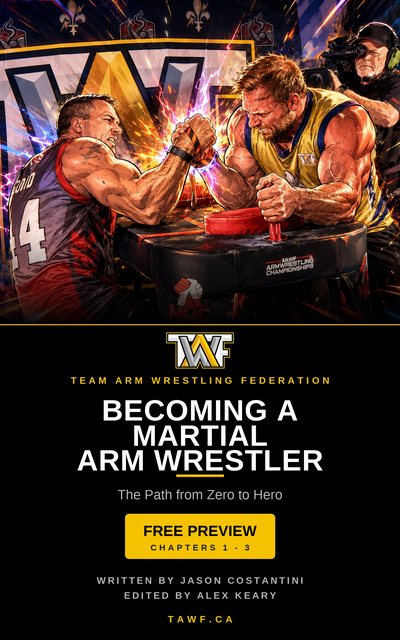
Almost everything that happens at an arm wrestling table is a variation on three attacks: the hook, the toproll, and the press. Understanding what each one does — and the grip and pressure concepts underneath them — is the difference between muscling at your opponent and actually arm wrestling them.
The concepts behind every move
Before the techniques themselves, a few ideas explain why they work.
Pronation and supination
These are the two ways your forearm rotates. Supination turns your palm up and toward you; it strengthens your wrist and is the heart of the hook. Pronation turns your palm down and away; it lets you attack over the top of your opponent's hand and is central to the toproll. Controlling the rotation of both your hand and your opponent's is most of the battle.
Wrist control
The wrist is the steering wheel. Cupping — curling your hand toward the inside of your forearm — flexes and strengthens your wrist and pulls your opponent's fingers back, weakening them. A puller whose wrist stays cupped and strong usually controls the match; a puller whose wrist gets flattened and opened is usually losing.
Pressure and posture
Strong pullers don't just push sideways toward the pin pad. They combine:
- Back pressure — pulling your hand back toward your own shoulder, dragging the opponent toward you and opening up their elbow angle so they lose leverage.
- Side pressure — driving across toward the pin pad.
- Posting, or the "riser" — keeping your knuckles and wrist above your opponent's and pressing upward, closing down their elbow angle to set up an attack.
- Bodyweight — getting your shoulder behind and over your hand so your whole body, not just your arm, applies force.
Good posture keeps your hand high and close to your body with your shoulder loaded behind it. Reaching out, leaning back, or letting your arm drift behind your body is both weak and dangerous.
The hook
The hook is an inside move. You supinate — turning your hand inward toward yourself — and curl your wrist to bring your opponent into a close, cupped grip. From there you apply back pressure and bodyweight, rolling your opponent's hand into a position where you can drive it down on the inside.
- Strengths: It plays to raw wrist, hand, and bicep strength, and it shortens the match. It is the natural style for powerful, thick-armed pullers.
- Watch for: Because you are working close and inside, a hooker who lets the wrist open or the elbow slide can be toprolled or stripped.
Beginners gravitate to the hook because it rewards raw strength directly — but it also loads the biceps and elbow the hardest, which is why new pullers are usually better served spending their first weeks on the outside (toproll) lane while their tendons adapt.
The toproll
The toproll is an outside move, and it is the great equalizer for technical pullers. Instead of fighting strength-on-strength, you pronate and slide your grip up toward your opponent's fingertips. This robs them of leverage — a hand attacked at the fingers can generate far less force — then you open their hand and wrist and "roll" the pressure back toward yourself and down.
- Strengths: It neutralizes a stronger opponent by attacking their weakest point. Hand and finger length, wrist strength, and timing matter more than sheer mass.
- Watch for: Toprolling depends on winning the grip and the start. A hooker who closes the distance before you can move up your opponent's hand can shut the technique down.
The press
The press (sometimes called a shoulder press or triceps press) is a forward power move. Rather than pulling the opponent toward you, you drive your weight and shoulder forward and over the top, using your triceps and bodyweight to push their hand down toward the pad.
- Strengths: It is devastating from a strong starting position and as a finishing move once you have established control. It leans heavily on shoulder and triceps strength and good bodyweight transfer.
- Watch for: Pressing commits your body forward. If your opponent absorbs it and your wrist isn't controlling theirs, you can over-extend and lose your posture.
How the techniques fit together
No serious competitor relies on only one move. Most have a primary style — many of the sport's biggest names are known as dedicated hookers or dedicated toprollers — and use the others as transitions and counters. A toproller might press to finish once they've stripped the hand; a hooker might briefly roll to set up their inside attack.
For beginners, the safest path is to spend your first weeks on the outside — drilling the toproll and a clean grip while your tendons and elbows adapt — before leaning hard on the inside hook, which loads the joint hardest. Once your structure holds up under load, commit to the style that best suits your build and add a second move to cover its weaknesses.
Training the techniques
Technique without sport-specific strength stalls quickly. The positions that win matches — a cupped, supinated wrist; a pronated finger attack; a loaded shoulder — should be trained directly with table time, partner drills, and tools like grippers, wrist rollers, and handle work. And as always, build the supporting tendons and ligaments gradually: connective tissue adapts more slowly than muscle, and most arm wrestling injuries trace back to a position the body wasn't ready for.
For a full breakdown of the exercises and how to program them, see how to train for arm wrestling; to understand the muscles behind each move, see what muscles arm wrestling works. For the safety fundamentals every puller should master first, see Arm Wrestling 101 and arm wrestling injuries. For the words used to describe these moves, see the glossary.