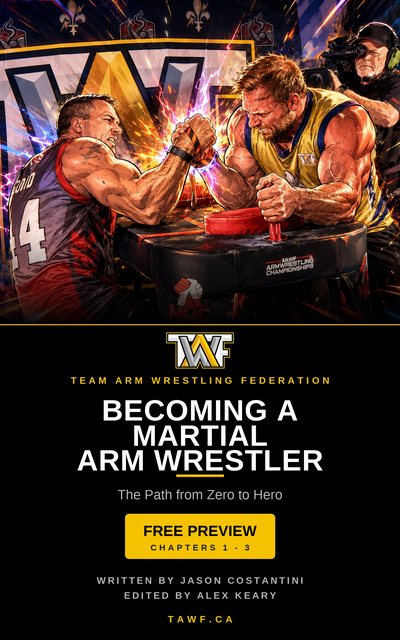
Arm wrestling is a combat sport, and like any combat sport it carries real risk. The good news is that its most serious injury — a broken arm — is both well understood and largely preventable. Understanding how it happens is the single best thing a new puller can do to stay safe.
The injury everyone worries about: the broken arm
The signature arm wrestling injury is a spiral fracture of the humerus, the long bone of the upper arm. In the most-studied medical series, every such fracture was a spiral break in the lower third of the bone, and about a quarter also involved temporary damage to the nearby radial nerve — which can cause a transient "wrist drop" until it heals.
It is important to be clear-eyed: this is a genuine fracture that usually needs either surgery or weeks in a cast, with months of rehabilitation. But it is not random, and it is not common in people who pull correctly.
Why the bone spirals
The break is a twisting failure, not a downward one. Force in arm wrestling comes from rotating the shoulder inward while the elbow stays bent and locked. That combination winds the upper-arm bone like a spring. The lower third of the humerus is the weakest point — its shape and structure make it the place that gives way — so when the twisting load gets too high, the bone fails there in a spiral.
The danger multiplies when the arm leaves its safe line. If the elbow drifts outside the shoulder, the arm falls behind the body, and the torso twists away from the hand, you stack sideways bending on top of the twist. That is the configuration coaches call the "broken arm position," and it is the one to avoid at all costs.
The "losing position" is the dangerous moment
There is a specific instant when arms break: the moment a losing puller refuses to give up. As you start to lose, the muscles that were driving your arm forward are forced to work in reverse — lengthening under load instead of shortening. That sudden reversal spikes the twisting force on the bone right when you are most desperate to save the match.
This is why the instinct to fight to the very end is exactly the wrong one. A trained competitor feels a lost position and concedes the pin; the bone is fine. A casual puller throws their whole body into saving it — and that is when it snaps.
Who actually gets hurt
The pattern in the medical literature is remarkably consistent:
- Young men, on the dominant arm. The large majority of fractures are in males roughly in their teens to thirties, usually on the right (dominant) arm.
- Amateurs, not competitors. Nearly every fracture happens in a casual or "bar" match. Sanctioned competition — with refereed positioning, weight matching, and the option to tap — is comparatively safe.
- Not caused by a stronger opponent. Reviews are explicit that the opponent's strength does not determine whether the bone breaks. Fractures happen between evenly matched people. The cause is the victim's own poor positioning and refusal to concede, not being out-muscled.
There is also an age twist: in teenagers whose bones are still growing, the weak point isn't the shaft but the growth plate at the inside of the elbow, which can be pulled off (a "medial epicondyle" avulsion). It's a different injury with its own precautions — see youth & junior arm wrestling.
Other arm wrestling injuries
The broken arm gets the attention, but the sport can also cause:
- Tendon and muscle tears — most notably ruptures of the biceps or the shoulder's rotator muscles, from the high isometric loads.
- Elbow ligament injuries — sprains or tears of the inner-elbow (medial collateral) ligament.
- Thumb and wrist strains — including thumb-ligament injuries from grip battles.
Most of these, like the fracture, are loads the body simply wasn't conditioned for — which points straight at prevention.
How to prevent it
Almost every safety rule comes back to keeping the arm in a strong, in-front-of-the-body line and not being too proud to lose:
- Keep your arm in front of you. Elbow inside your shoulder, shoulder behind and over your hand. Never let the arm fall behind your body.
- Don't twist your torso. Keep your eyes on your gripping hand — it stops your body from rotating into the danger position.
- Concede a lost position. Tap or give the pin before your form breaks. A loss is nothing; a spiral fracture is months.
- Warm up the wrist, elbow, and shoulder. Cold connective tissue fails more easily.
- Match up fairly and never arm wrestle children, whose growth plates are vulnerable.
- Build connective-tissue strength gradually. Tendons and ligaments adapt more slowly than muscle, so the body needs time to be ready for table loads — see how to train for arm wrestling.
What to do if it happens
A snapped humerus is a medical emergency — the person will usually hear or feel it go and cannot use the arm. Get medical care immediately and do not try to "set" it. The encouraging part: both surgical fixation and non-surgical casting heal well, with most people returning to normal heavy use within about a year. Many who experience it, however, never arm wrestle again — which is the strongest argument for pulling safely from the start.
Where to go next
- Master the safe basics in Arm Wrestling 101.
- Understand what muscles do the work and why the "losing position" is risky.
- Train the supporting tendons properly with our training guide.
- Avoid the common myths and mistakes that get beginners hurt.