Full Pro
8v8
The Official 8v8 Franchise Game: city-versus-city play between eight franchises, with a manager on every bench and the complete TAWF point system.
Before you pull
- Your weight classes
- Men: Lightweight 0–175 lbs, Middleweight 176–205 lbs, Heavyweight 206–245 lbs, Superheavy 246+ lbs.
- How many matches you pull
- A game is 32 matches in 4 rounds of 8: one left-arm and one right-arm match in each class, every round. A game fields 8 of the 12 on the roster, and the Manager picks who pulls each match before each round.
- Who calls gambles and timeouts
- The Manager: 2 gambles, 2 timeouts of 2 minutes, and a forced review of any call, which costs a timeout if the call stands.
- How you win
- First to 100 points, or the most points after all 32 matches. A tie goes to extra rounds until a team reaches 100.
- The rule that catches people out
- The roster locks 48 hours before the game, with no reserves after the lock. Miss weight and your team competes without you.
- Flagrant foul
- The opponent takes the match as a +5 win. The Head Referee may eject, and the league reviews every flagrant foul.
The league
TAWF fields eight franchises: four in the Canadian Conference and four in the US Conference. Teams play within their conference through the regular season and meet across conferences in the Grand Final.










Women. Each league team has three women on its roster. They pull a women's 3v3 league game, on the women's classes, before the men's 8v8 game. Women also compete in the No Elimination Tournament.
Weight classes
| Class | Range |
|---|---|
| Lightweight | 0–175 lbs |
| Middleweight | 176–205 lbs |
| Heavyweight | 206–245 lbs |
| Superheavy | 246+ lbs |
Your weigh-in weight sets your class. Decimals round down, so the decimal never moves you up: 175.9 lbs is Lightweight, and 176 lbs is Middleweight. These are the 8v8 classes only; the 3v3 and No Elimination use their own.
Roster and weigh-in
- A roster has 12 athletes, three per weight class.
- A game fields 8: two per class, one for the left arm and one for the right.
- The roster locks 48 hours before the game. No roster changes after the lock, and no reserves.
- If an athlete fails to make weight, the team competes without that athlete.
- There is no clothing allowance at weigh-in. The weigh-in rules for every format are in the shared rules on the Official Rules page.
Manager, captain and substitutions
| Role | What they do |
|---|---|
| Manager | The team's decision-maker. Picks the roster at the draft, decides who pulls each match, calls substitutions, gambles and timeouts, and is the only person who may challenge a referee's call. |
| Captain | Chosen by the Manager at the start of each game as the face of the team. No duties beyond competing. Earns +1 for each match won. |
| Substitutions | Among the 8 athletes fielded in that game, declared before a match begins. The opposing team then has 30 seconds to answer with a substitution of its own. |
The game
An 8v8 game is 4 rounds of 8 matches, 32 in all. Each round pulls one left-arm and one right-arm match in each class, Lightweight first, in the same order every round:
| Match | Class | Arm |
|---|---|---|
| 1 | Lightweight | Left |
| 2 | Lightweight | Right |
| 3 | Middleweight | Left |
| 4 | Middleweight | Right |
| 5 | Heavyweight | Left |
| 6 | Heavyweight | Right |
| 7 | Superheavy | Left |
| 8 | Superheavy | Right |
Before each round, Managers have 2 minutes to submit their picks for each match. After that, a pick changes only by substitution. The clock between matches runs 30 seconds.
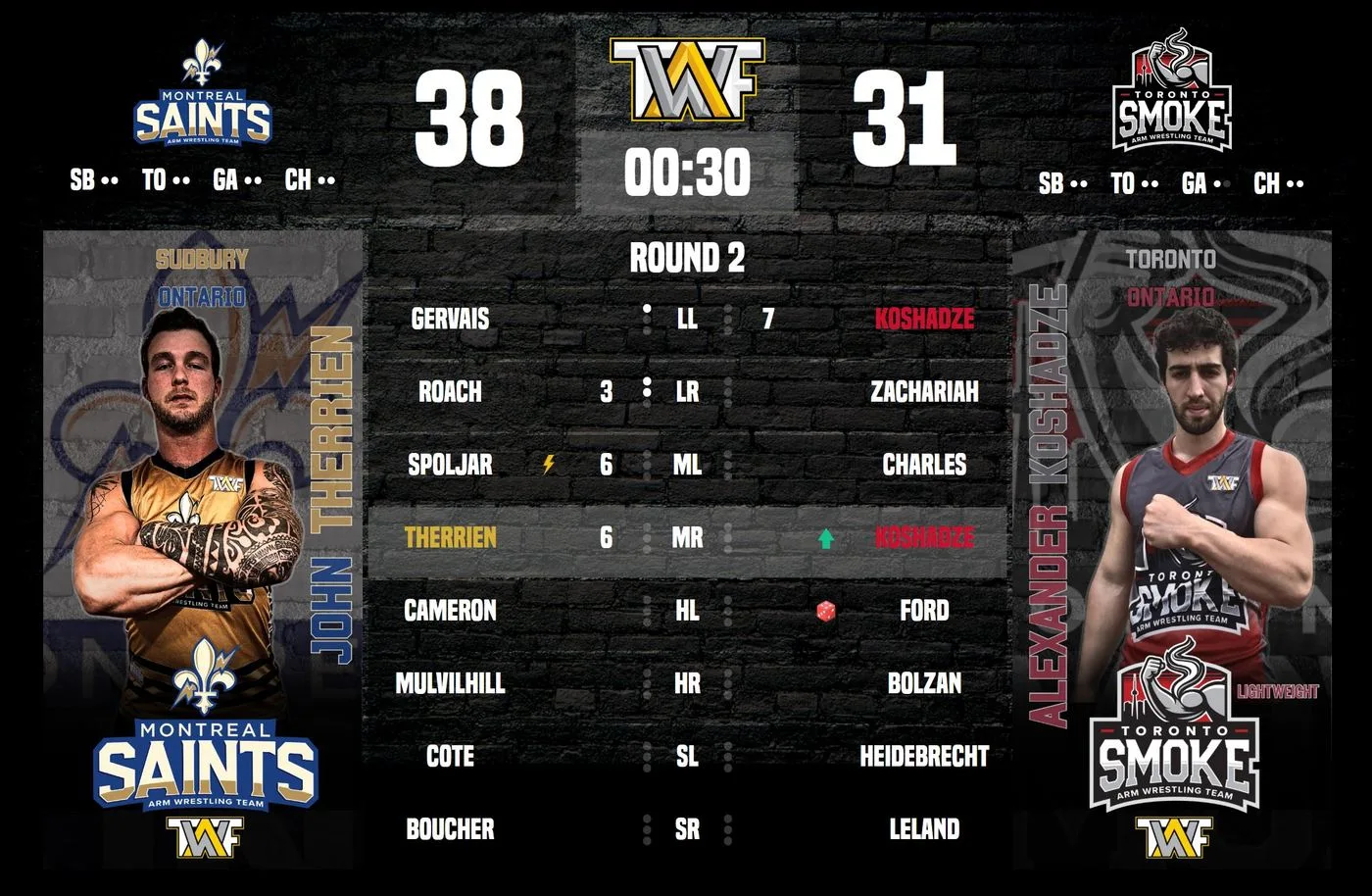
Gambles, timeouts and review
2
Gambles per game
Each one doubles a match's points. If both teams gamble the same match, the points triple.
2
Timeouts per game
2 minutes each, for strategy, injury or a regroup.
Any call
Forced review
The Head Referee rules from the footage. If the original call stands, the team loses one timeout.
All three are the Manager's. A gamble or a timeout is called before the match starts; once a match starts, neither can be called until it ends. The position command, “look at your hand,” is for the athlete's awareness only: it is not a warning, it carries no foul, and the match does not stop. An athlete may ask the referee for clarification during setup, but may not argue with or challenge a call.
8v8 scoring
The 8v8 uses the points every format shares, plus these:
| Bonus | Points | When |
|---|---|---|
| Captain win | +1 | A match won by the team captain. |
| Pulling Up | +1 per class | A lighter athlete winning in a heavier class earns +1 for each class above their own. |
| Shutout | +5 team | Winning all 4 matches in one class and arm. Flat: never multiplied by a gamble. |
| Gamble, one team | 2x | Everything in that match doubles, including the Pulling Up bonus. |
| Gamble, both teams | 3x | Both teams gamble the same match: the points triple. |
Pulling Up in the 8v8 is the Manager's call: picking a lighter athlete to pull in a heavier class for the bonus.
Flagrant foul
A flagrant foul is unsportsmanlike conduct, such as arguing with the referee or aggressive actions after a match. The opponent takes the match as a +5 win. The Head Referee may also eject, at their discretion, and the league reviews every flagrant foul.
Winning the game
A team wins by being first to 100 points, or by holding the most points after all 32 matches. There is no early win by point margin. A game tied after 32 matches goes to extra rounds until a team reaches 100.
The season
Season 1 is a 12-game regular season across the league, three games for each team, all within its own conference, one game each Saturday for 12 weeks. A rest week follows, then the Grand Final: 14 weeks in all.
Standings
Teams are ranked by win-loss record. Total points break any tie in the record.
The Grand Final
One game: the top team in the Canadian Conference against the top team in the US Conference. There are no semi-finals in Season 1. Referee roles, injury protocols and the code of conduct are the same in every format and are in the shared rules on the Official Rules page.
Disputes and prizes
Game disputes
A Manager who believes a call was wrong may request a game dispute right after the game. A review committee of TAWF officials examines the footage, and its decision is final: if the outcome changes, the score is adjusted and a re-game may be scheduled. Game disputes exist only in the 8v8; in the 3v3 and No Elimination the Head Referee's call is final.
Prizes
The winning team of each game shares the game's prize pool evenly among its athletes and managers. The Season Champion takes the TAWF Trophy and prize money. Prizes are handed out at the Post-Event Ceremony; a team or athlete found to have broken the code of conduct may forfeit its prize, at the review committee's decision.
8v8: questions
What are the weight classes?+
Four men's classes: Lightweight 0–175 lbs, Middleweight 176–205 lbs, Heavyweight 206–245 lbs, Superheavy 246+ lbs. Each format has its own set, and all of them follow one pattern: a class runs up to the .9 of its top pound, and the next class starts on the whole pound.
How many athletes are on a team?+
A roster of 12, three per weight class. A game fields 8: two per class, one for the left arm and one for the right.
How do you win a game?+
First to 100 points, or most points after 32 matches. A tie goes to extra rounds until a team reaches 100. There is no early win by point margin.
How many gambles and timeouts do we get?+
2 gambles and 2 timeouts of 2 minutes per team per game, called by the Manager before a match starts. A gamble doubles a match's points. If both teams gamble the same match, the points triple.
The referee said "look at your hand." Is that a foul?+
No. It is for your awareness only. It is not a warning, it carries no foul, and the match does not stop.
What does a flagrant foul cost?+
The match: the opponent takes it as a +5 win. The Head Referee may also eject, and the league reviews every flagrant foul.
Can I challenge a call?+
Only the Manager can, by forcing a review. The Head Referee rules from the footage, and if the call stands, the team loses a timeout. A Manager may also request a game dispute right after the game. An athlete may ask the referee for clarification during setup, but may not argue with or challenge a call.
What is Pulling Up?+
Sending an athlete to pull in a heavier class than their own, for a bonus. The Manager can pick a lighter athlete for a heavier class. Each win earns +1 for each class above the athlete's own. A gamble doubles the Pulling Up bonus along with the rest of the match.