Semi-Pro
3v3 Team Showdown
For clubs sending a team of three. The strategy and point system of the 8v8, in a short, fast team game with no manager.
Before you pull
- Your weight classes
- Men: Lightweight 0–180 lbs, Middleweight 181–210 lbs, Heavyweight 211+ lbs. Women pull the 3v3 in the Women's Division of the 8v8: three women on every league roster, in a league game before the men's 8v8.
- How many matches you pull
- A game is 12 matches in four rounds of three, one per class: two rounds on the left arm, then two on the right. All three of you pull every game, on both arms. Every team gets at least two games.
- Who calls gambles and timeouts
- There is no manager. The athlete pulling the match calls the team's one gamble; any team member may call one of its two timeouts. Both before the match starts.
- How you win
- First to 100 points, or the most points after all 12 matches. A tie goes to the Silver Bullet, a 13th match.
- The rule that catches people out
- Your lineup, pull-ups included, is one lineup for both arms, locked before the first match of the game starts.
- Flagrant foul
- The opponent takes the match as a win, and you are out for the rest of the game and the tournament: each of your later matches is a forfeit at a flat +5.
What the 3v3 is
The 3v3 is a condensed TAWF team game. It keeps the strategy and the point system of the 8v8 but drops the manager's bench: three athletes, twelve matches, about twenty minutes. It is the middle rung of the ladder. Teams compete for the pot, and pullers earn the profile that puts them in front of franchise rosters.
Where it runs. The 3v3 Team Showdown is a local TAWF tournament for clubs in and around the region, for men's teams of three; no co-ed or mixed teams. The Women's Division of the 8v8 is a women's 3v3 league game: each league team has three women on its roster, who pull it on the women's classes before the men's 8v8 game.
The game rules on this page apply to every 3v3. The tournament section below the divider applies to the 3v3 Team Showdown.
Weight classes
The 3v3 uses three weight classes. Which set you pull in depends on where you pull.
| Class | Range |
|---|---|
| Lightweight | 0–180 lbs |
| Middleweight | 181–210 lbs |
| Heavyweight | 211+ lbs |
| Class | Range |
|---|---|
| Lightweight | 0–160 lbs |
| Middleweight | 161–180 lbs |
| Heavyweight | 181+ lbs |
Your weigh-in weight sets your class. Decimals round down, so the decimal never moves you up: in the men's classes, 180.9 lbs is Lightweight and 210.9 lbs is Middleweight. These are not the 8v8 classes. The women's classes are the same in every TAWF format.
Team, captain and lineup
- A team is three athletes, and all three pull every game, on both arms. There is no bench, there are no substitutions, and there is no manager.
- Each athlete pulls for only one team for the whole tournament.
- The team names a captain for each game. The captain is named for the +1 Captain Win bonus only, and carries none of an 8v8 manager's duties.
Pulling Up
An athlete may pull in their own class or any heavier class, never a lighter one. Any number of athletes may pull up. Each win by an athlete who pulled up earns +1 per class jumped.
Example: a team of three Lightweight athletes. One pulls Lightweight, one pulls up into Middleweight for +1 a win, and one pulls up into Heavyweight for +2 a win.
The lineup
Before each game the team declares its lineup: who pulls Lightweight, Middleweight and Heavyweight, pull-ups included. It is one lineup for both arms, and so is the captain. Both lock before the game's first match starts and stay locked until the game ends. A team may change its lineup between games. That makes the 3v3 lineup a pre-game decision, unlike the 8v8, where the Manager picks matchups round by round.
The game
A 3v3 game is 12 matches in four rounds. Each round is three matches, one per class, Lightweight first. Rounds 1 and 2 are pulled on the left arm, rounds 3 and 4 on the right, so each class pulls four: two left, two right.
Swipe to see all columns.
| Round | Arm | Match 1 | Match 2 | Match 3 |
|---|---|---|---|---|
| 1 | Left | 1 Lightweight | 2 Middleweight | 3 Heavyweight |
| 2 | Left | 4 Lightweight | 5 Middleweight | 6 Heavyweight |
| 3 | Right | 7 Lightweight | 8 Middleweight | 9 Heavyweight |
| 4 | Right | 10 Lightweight | 11 Middleweight | 12 Heavyweight |
The clock between matches runs 30 seconds.
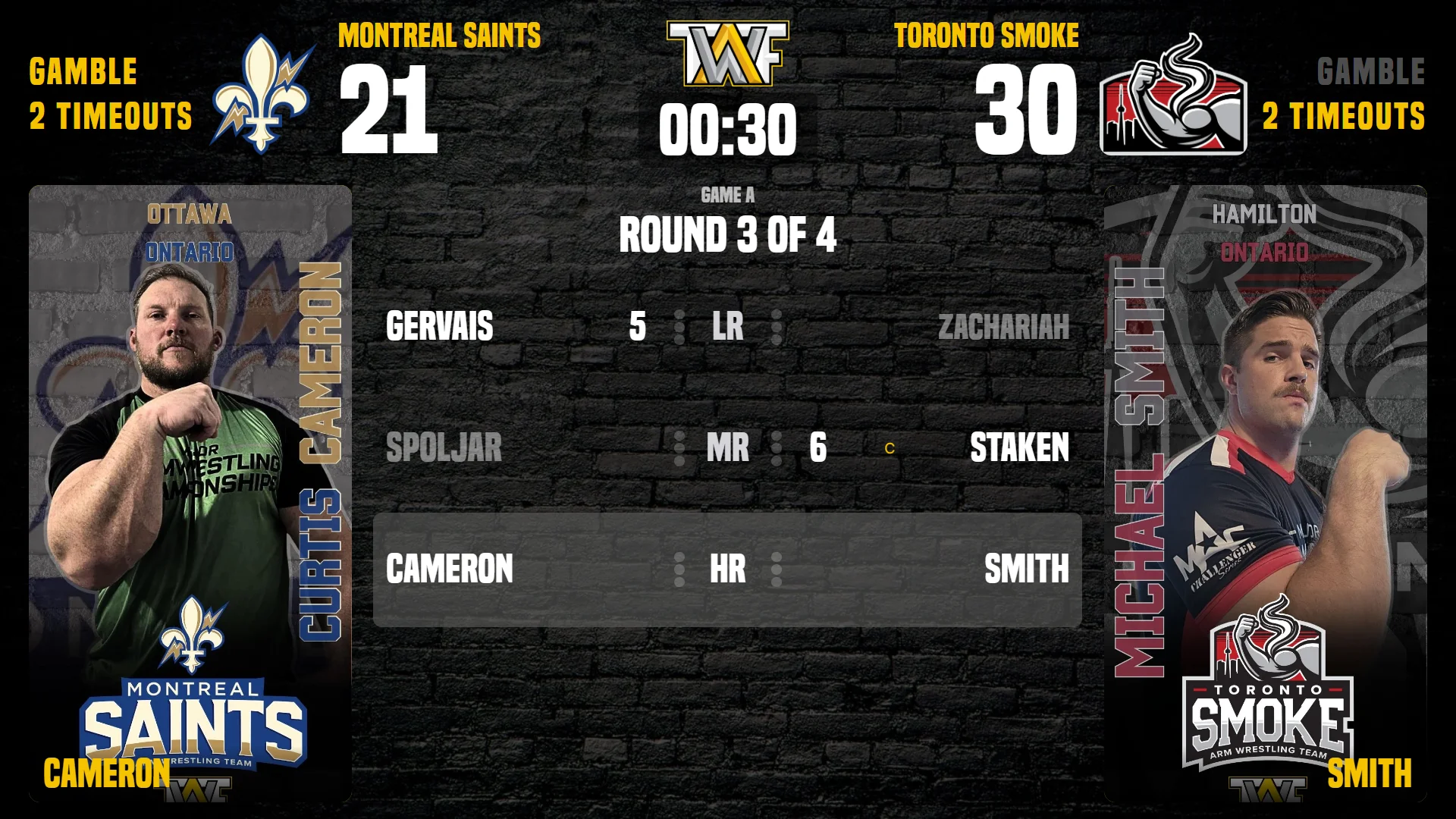
Gambles and timeouts
1
Gamble per team per game
Doubles everything in that match. If both teams gamble the same match, the points triple.
2
Timeouts per team per game
2 minutes each, charged to the team.
With no manager, the athletes decide. The athlete who is pulling calls a gamble before the match starts. Any team member may call a timeout before the match starts. Once a match starts, no gamble or timeout can be called until it ends.
3v3 scoring
The 3v3 uses the points every format shares, plus these:
| Bonus | Points | When |
|---|---|---|
| Captain win | +1 | A match won by the team's captain. |
| Pulling Up | +1 per class | A win by an athlete who pulled up, for each class jumped. |
| Shutout | +5 team | Winning all 4 matches in one class, both arms, at the table. A forfeit or a flagrant win does not count toward it. Flat: never multiplied by a gamble. |
| Gamble, one team | 2x | Everything in that match doubles, including the Pulling Up bonus. |
| Gamble, both teams | 3x | Both teams gamble the same match: the points triple. |
Calls and review
There is no forced review in the 3v3. The Head Referee's call is final and cannot be reviewed.
The position command, “look at your hand,” is for awareness only, the same as the 8v8. It is not a warning, it carries no foul, and the match does not stop.
Late to the table
When a match ends, the next two athletes have 30 seconds to get to the table. An athlete not at the table when the clock reaches 0:00 takes a foul, and the clock resets to 30 seconds. Still not there 30 seconds later is a second foul and another reset. A third late foul is three fouls, so the athlete fouls out and loses the match.
Forfeit, injury and flagrant foul
Three things take an athlete out of the Showdown: a forfeit, an injury that stops them continuing, and a flagrant foul. In each case the athlete loses the match being pulled and is out for the rest of the game and the tournament. Every later match of theirs is a forfeit to the present opponent at a flat +5, with no bonuses and no foul swing, taken in rotation as it comes up. There is no bench, so the slot stays open.
Flagrant foul
A flagrant foul is unsportsmanlike conduct, such as arguing with the referee or aggressive actions after a match. The opponent takes the match as a win, and the offender is out for the rest of the game and the tournament. The win is scored with the points earned in the match so far: +5, the foul swing, and any captain and Pulling Up bonuses, under a gamble if one was called. The Head Referee may also eject, at their discretion.
Winning the game
A 3v3 game is won by reaching 100 points, or by holding the most points after all 12 matches.
The Silver Bullet
A game tied after all 12 matches is decided by the Silver Bullet, a 13th match:
- A coin toss. The winner gets first choice and picks the weight class.
- The loser of the toss picks the arm.
- It is pulled by the athlete who holds that class in the team's locked lineup, whether or not that athlete pulled up. Its points are added to the final score and decide the game.
Tournament
3v3 Team Showdown
Everything from here down applies to the 3v3 Team Showdown tournament.
The tournament
A Showdown is a one-day tournament of two qualifying rounds and two finals. Every team plays two qualifying games; the top four then play the finals, so a finalist plays three games on the day. Games run back to back, with no more than a 5-minute grace period between the end of one game and the start of the next.
- The field. 4 to 12 teams. If registration closes on an odd number, a standby team enters to keep the field even, so no team takes a bye. A Showdown can also run with exactly 2 teams: then the day is one game, the Championship.
- Seeding. TAWF seeds the teams, 1st to last, and publishes the seeding at check-in.
- Round 1. Adjacent seeds meet: the 1st seed plays the 2nd, the 3rd plays the 4th, and so on down the field. The games are lettered in that order: Game A, Game B, Game C.
- Round 2. Winners play winners and losers play losers, in letter order: the winner of Game A plays the winner of Game B, the loser of A the loser of B, and so on. With an odd number of games one winner and one loser are left over, the winner of the last game and the loser of the first, and they play each other. No team meets the same opponent twice.
- Finals. The top four teams in the standings advance: Third Place, then the Championship.
The table shows every Round 2 pairing by field size. WA is the winner of Game A, LA its loser.
Swipe to see all columns.
| Field | Game A | Game B | Game C | Game D | Game E | Game F |
|---|---|---|---|---|---|---|
| 4 teams | WA v WB | LA v LB | ||||
| 6 teams | WA v WB | LB v LC | LA v WC | |||
| 8 teams | WA v WB | WC v WD | LA v LB | LC v LD | ||
| 10 teams | WA v WB | WC v WD | LD v LE | LB v LC | WE v LA | |
| 12 teams | WA v WB | WC v WD | WE v WF | LA v LB | LC v LD | LE v LF |
Standings
After the two qualifying rounds, teams are ranked in this order:
- Win-loss record.
- Cumulative TAWF point differential.
- Head-to-head result, when exactly two teams are tied and they played each other.
- Total TAWF points scored.
The top four teams in the standings go to the finals.
Finals and prizes
Two finals, each a normal 3v3 game, pulled in this order:
- Third Place: the 3rd team in the standings against the 4th. The winner places 3rd, the loser 4th.
- Championship: the 1st team in the standings against the 2nd. The winner is the Showdown champion, the loser places 2nd.
The top three teams take medals and prize money.
3v3 Team Showdown: questions
What are the weight classes?+
Three men's classes: 0–180, 181–210 and 211+ lbs. The Women's Division of the 8v8, the women's 3v3 league game each league team's three women pull before the men's 8v8 game, uses the women's classes. Each format has its own set, and all of them follow one pattern: a class runs up to the .9 of its top pound, and the next class starts on the whole pound. The women's classes are the same in every format: 0–160, 161–180 and 181+ lbs.
How many athletes are on a team?+
Three, and all three pull every game on both arms. There is no bench and no manager.
How do you win a game?+
First to 100 points, or most points after 12 matches. A tie goes to the Silver Bullet, a 13th match whose points decide the game.
How many gambles and timeouts do we get?+
1 gamble and 2 timeouts of 2 minutes per team per game. The athlete who is pulling calls a gamble before the match starts; any team member may call a timeout before the match starts. A gamble doubles a match's points; if both teams gamble the same match, the points triple.
The referee said "look at your hand." Is that a foul?+
No. It is for your awareness only. It is not a warning, it carries no foul, and the match does not stop.
What does a flagrant foul cost?+
The opponent takes the match as a win, and you are out for the rest of the game and the tournament: each of your later matches is a forfeit at a flat +5. The win is scored with the points earned in the match so far: +5, the foul swing, and any captain and Pulling Up bonuses, under a gamble if one was called. The Head Referee may also eject.
What happens if one of us is injured?+
An athlete who cannot continue is out for the rest of the game and the tournament, the same as a forfeit or a flagrant foul. The match being pulled is lost, and each of their later matches is a forfeit to the present opponent at a flat +5. There is no bench, so the slot stays open.
Can I challenge a call?+
No. The Head Referee's call is final and cannot be reviewed. An athlete may ask the referee for clarification during setup, but may not argue with or challenge a call.
What is Pulling Up?+
Pulling in a heavier class than your own, for a bonus. An athlete may pull in their own class or any heavier one, never a lighter one, and any number of athletes may pull up. Each win by an athlete who pulled up earns +1 per class jumped, doubled or tripled under a gamble like the rest of the match. The lineup is declared before each game and locks before its first match starts.
Can a Showdown run with only two teams?+
Yes. With exactly 2 teams the day is one game, the Championship, under the same rules as any final; the winner places 1st and the loser 2nd. Otherwise a Showdown needs 4 or more teams, and an odd field takes a standby team.