Amateur
No Elimination
For individual athletes, newcomers and experienced pullers alike. Everyone pulls the same number of matches, and nobody is knocked out of their pulls.
Before you pull
- Your weight classes
- Men have five classes, women three, labeled by weight range. Decimals round down, so the decimal never moves you up.
- How many matches you pull
- Everyone in your group pulls everyone, and every athlete pulls the same number of matches: 4 in a group of 5, 7 in a group of 8.
- Not used here
- No gambles, no captain or shutout bonus, no timeouts of any kind (including the injury timeout) and no forced review. The Head Referee's call is final.
- How you win
- Most points in your group wins it: +5 a win, +1 a flash pin, +1 for each foul your opponent commits, -1 for each of your own, and +1 per class above your own if you pull in a heavier class.
- The rule that catches people out
- "Look at your hand" is said once. If you do not correct your position, the referee stops the match and calls a Position foul. Only in No Elimination.
- Flagrant foul
- A flagrant foul puts you out: every later match of yours is a +5 win for your opponent, and you are not ranked and take no medal.
What No Elimination is
No Elimination is the open entry tier of TAWF: an individual tournament with no knockout. Everyone in a group pulls everyone else. Points rank the field and crown a group winner, but nobody is knocked out of their pulls.
Why it exists. In a standard double-elimination bracket, a newcomer can draw a top athlete in their first match, lose a close second match on fouls, and be done for the day after two pulls. In No Elimination, every athlete pulls the same number of matches and gets the same chance at the table, winning or not.
Who it is for. Newcomers and experienced pullers, side by side. There is no separate amateur bracket, because the mixing is the point: a newcomer earns table time against seasoned athletes instead of losing it.
Women. Every woman who wants to compete has a place in No Elimination. Women also compete in the Women's Division of the 8v8: each league team has three women on its roster, who pull a women's 3v3 league game before the men's 8v8 game.
Weigh-in, classes and divisions
Your weigh-in weight sets your class. No Elimination classes are labeled by their weight range, not by name. Men have five classes, women three.
| Range |
|---|
| 0–160 lbs |
| 161–180 lbs |
| 181–200 lbs |
| 201–220 lbs |
| 221+ lbs |
| Range |
|---|
| 0–160 lbs |
| 161–180 lbs |
| 181+ lbs |
Decimals round down, so the decimal never moves you up: 160.9 lbs is in the 0–160 lbs class, and 161 lbs starts the next one. These classes apply to No Elimination only. The women's classes are the same in every TAWF format.
A division is one sex, one arm and one class. Right-arm and left-arm competitions are separate divisions, so an athlete entering both arms is in two divisions.
Pulling Up. You may enter a class heavier than your weight, never a lighter one, at registration, confirmed at weigh-in. A win in a heavier class earns +1 point for each class above your own.
Groups
Once a division is set at weigh-in, its athletes are placed into groups of 3 to 8.
- A division of 8 or fewer athletes is one group.
- A division of more than 8 is split into the fewest groups of 8 or fewer: the athlete count divided by 8, rounded up. No two groups in a division differ by more than one athlete.
- The field is dealt across the groups lightest first, so every group spans the class.
| Athletes | Groups | Group sizes |
|---|---|---|
| 17 | 3 | 6, 6, 5 |
| 25 | 4 | 7, 6, 6, 6 |
Divisions of one or two
A division of one or two athletes does not run. Staff move those athletes up into the next heavier class the event offers on that arm, never down. Each athlete is told at weigh-in and may withdraw instead; the entry fee does not change. A moved-up athlete competes and places in the class they moved into, and earns +1 point per class moved on every win, the same as Pulling Up.
The Group Battle
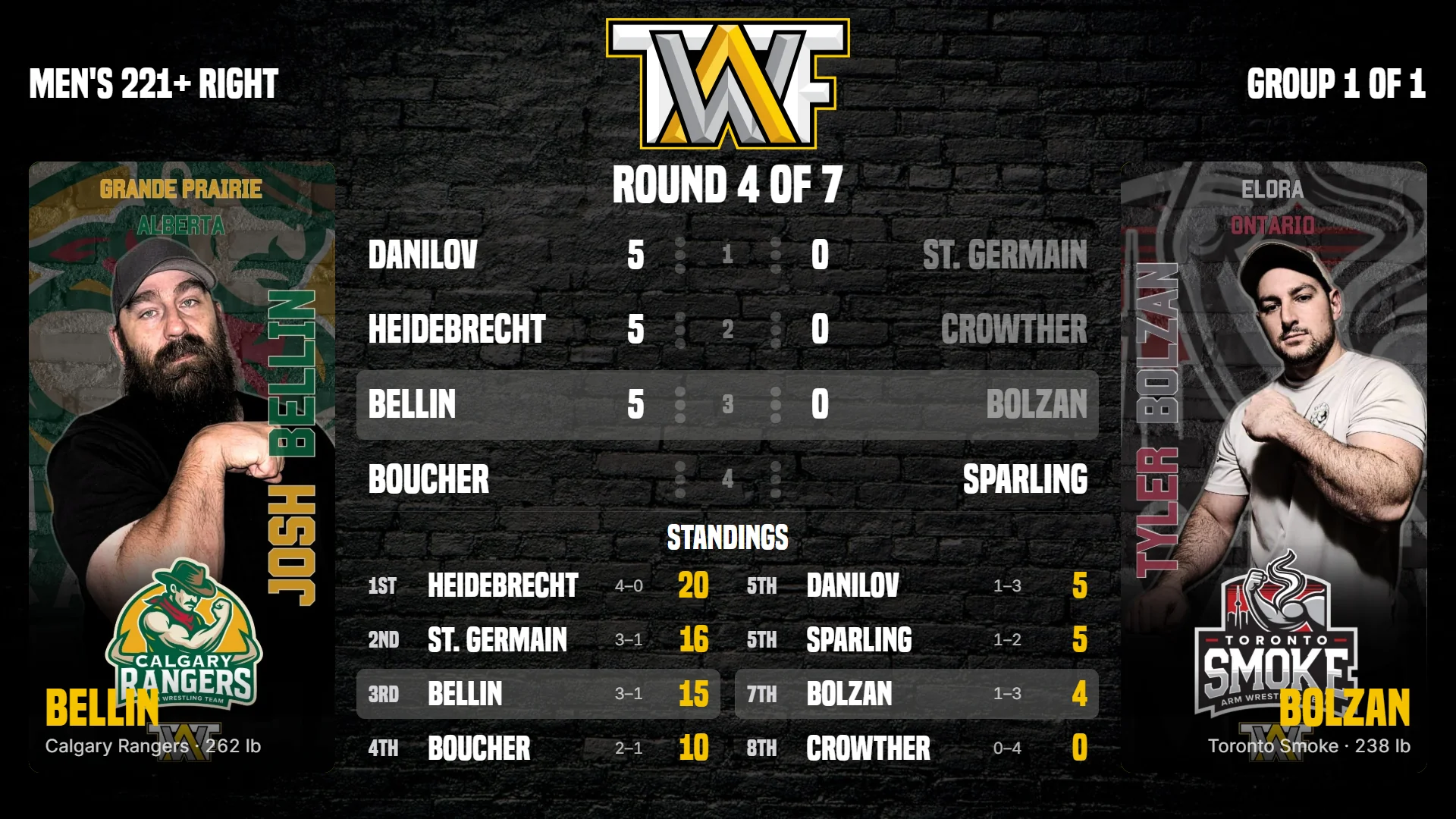
Each group pulls a round robin called the Group Battle: every athlete pulls every other athlete in the group. It runs in rounds, and the matches in a round are pulled side by side.
The rotation is the fixed-anchor circle method, and keeping to it is not optional. It is the fairness of the format: rest between matches stays as even as possible for every athlete, and each athlete's matches are spaced evenly through the Group Battle.
- Athletes get lettered positions: A, B, C and so on, lightest first.
- Position A never moves. Every other position moves one spot each round, in a fixed direction, until everyone has pulled everyone once.
- Odd-numbered group: position A is the bye. The athlete opposite the bye has no match that round. Every athlete byes exactly once, so everyone pulls the same number of real matches. A bye is recorded, not pulled. It scores no points and is not a win.
- Groups of 3 or 4 run the full rotation twice, so each athlete pulls each opponent twice.
Example: a group of 5. It uses six positions, A to F: A is the bye, and B to F are the five athletes.
| Round | Bye | Match | Match |
|---|---|---|---|
| 1 | A vs F | B vs E | C vs D |
| 2 | A vs E | F vs D | B vs C |
| 3 | A vs D | E vs C | F vs B |
| 4 | A vs C | D vs B | E vs F |
| 5 | A vs B | C vs F | D vs E |
The match against A is the bye and is not pulled, so a group of 5 runs 5 rounds of 2 real matches, and every athlete pulls 4 matches.
Swipe to see all columns.
| Group size | Bye | Rounds | Real matches per round | Matches per athlete |
|---|---|---|---|---|
| 3 | Yes | 3, run twice | 1 | 2 per rotation, 4 in all |
| 4 | No | 3, run twice | 2 | 3 per rotation, 6 in all |
| 5 | Yes | 5 | 2 | 4 |
| 6 | No | 5 | 3 | 5 |
| 7 | Yes | 7 | 3 | 6 |
| 8 | No | 7 | 4 | 7 |
Scoring
Every match counts. Only the winner of a match scores, and every match's score is recorded and counted toward the athlete's TAWF standings and stats.
| Result | Points | Notes |
|---|---|---|
| Win | +5 | The athlete wins the match. |
| Loss | 0 | |
| Flash pin | +1 | The winner pins within 0.5 seconds of "Go." On a refereed pin only, never on a foul-out. |
| Opponent's foul | +1 per foul | For each foul the losing athlete committed in the match. |
| Own foul | -1 per foul | For each foul the winning athlete committed in the match. |
| Forfeit | +5 flat | To the present opponent. No bonuses and no foul swing. |
| Pulling Up | +1 per class | A pulled win in a class above the athlete's own, chosen or moved up by staff. |
Three fouls in one match is an automatic loss of that match, so the least a clean winner scores against a fouled-out opponent is +8, and the least any winner scores is +3.
The Position foul
This is the rule most likely to catch out an athlete who has pulled in another format.
No Elimination
- The referee says "look at your hand" once.
- If the position is not corrected, the referee stops the match and calls a Position foul.
3v3 and 8v8
The referee may say “look at your hand.” It is for your awareness only. It is not a warning, it carries no foul, and the match does not stop.
Position foul: failing to correct arm or shoulder position after the referee's command “look at your hand.” It is the only command-then-foul sequence in the TAWF rules, and it exists only in No Elimination. Every other foul is an immediate stop foul with no command first. A Position foul counts toward the three-foul loss and gives the opponent +1, like any other foul.
Flagrant foul
Unsportsmanlike conduct, such as arguing with the referee or aggressive actions after a match, is a flagrant foul. It puts the athlete out, the same way an injury or a forfeit does:
- The match it happens in is a normal loss, with the fouls recorded to that point.
- Every later match of that athlete is a +5 win for the opponent.
- The athlete is not ranked and takes no medal.
- In a finals battle, a flagrant foul in any of the three matches loses the battle.
Late to the table
Late works the same as in every format: not at the table when the clock reaches 0:00 is a foul, and the clock resets to 30 seconds. Two late fouls buy about 60 extra seconds of rest, and the athlete carries both fouls. The full rule, with the forfeit cases, is in the shared rules on the Official Rules page.
Ranking and the tiebreaker
At the end of a Group Battle, athletes are ranked by total points. The athlete with the most points wins the group.
If two or more athletes are tied on points, the tie is broken in this order:
- Head-to-head among the tied athletes.
- Win-loss record.
- Fewest fouls committed.
- A deciding pull between two, or a one-pass Group Battle among three or more.
A tie among three or more that narrows to two goes straight to a deciding pull. A deciding pull awards no points, only the win. Points from a tiebreak Group Battle order the tied athletes only and never join the group total.
- An athlete who forfeits is not ranked.
- An athlete who is injured and cannot finish stays ranked on the points earned, and places below an athlete who is otherwise level.
Finals and medals
- One group: no finals. The group ranking is the division result.
- Two groups: the two runners-up pull a battle for 3rd, then the two group winners pull a battle for 1st. Each battle is best of 3: the first athlete to win 2 matches takes it, so a battle can end after 2. The battle is decided by wins, not points, but every match in it is scored as usual and the points count toward the athlete's standings and stats.
- More than two groups: the group winners form a new group and pull one more Group Battle, one pass, ranked and tied the same way as the groups. The top three take the medals.
Medals are awarded per weight class and per arm: gold, silver and bronze.
No Elimination: questions
What are the weight classes?+
Five men's classes and three women's, labeled by weight range. Each format has its own set, and all of them follow one pattern: a class runs up to the .9 of its top pound, and the next class starts on the whole pound. The women's classes are the same in every format: 0–160, 161–180 and 181+ lbs.
How many athletes are on a team?+
None. It is an individual tournament.
How do you win?+
Most points in your group wins it. Ties go to head-to-head among the tied athletes, then win-loss, then fewest fouls, then a deciding pull between two, or a one-pass Group Battle among three or more. With two groups, the group winners pull a 3-match battle for 1st, won by taking 2 of the 3.
How many gambles and timeouts do we get?+
None. No gambles and no timeouts, including the injury timeout.
The referee said "look at your hand." Is that a foul?+
It can be. The command is given once. If you do not correct your position, the referee stops the match and calls a Position foul.
What does a flagrant foul cost?+
It puts the athlete out, like an injury or a forfeit. The match it happens in is a normal loss, with the fouls recorded to that point. Every later match of that athlete is a +5 win for the opponent, and the athlete is not ranked and takes no medal. In a finals battle, a flagrant foul in any of the three matches loses the battle.
Can I challenge a call?+
No. The Head Referee's call is final and cannot be reviewed. An athlete may ask the referee for clarification during setup, but may not argue with or challenge a call.
What is Pulling Up?+
Pulling in a heavier class than your own, for a bonus. You may enter a class heavier than your weight, never a lighter one, at registration, confirmed at weigh-in. A win in a heavier class earns +1 point for each class above your own. An athlete staff move up from a class too small to run earns the same.
What if only one or two athletes are in my No Elimination class?+
The class does not run. Staff move you up into the next heavier class the event offers on that arm, never down. You are told at weigh-in and may withdraw instead; the fee does not change. You compete and place in your new class, and earn +1 per class moved on every win.